Flapless Laser Vision Correction with PRK & Advanced Surface Ablation
Clear, 20/20 vision without a corneal flap. Experience safe, proven laser eye surgery designed for patients with thin corneas, active lifestyles, or dry eyes.
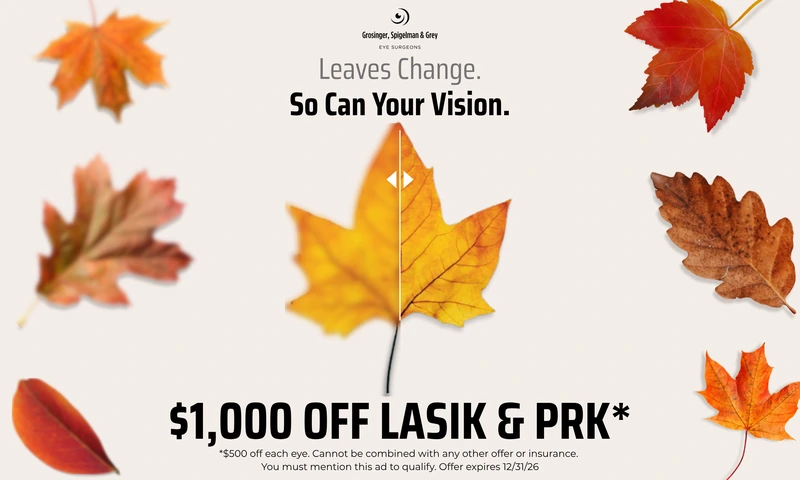
$500 off each eye. Cannot be combined with any other offer or insurance. You must mention this ad to qualify. Offer expires 12/31/26.
PRK (Photorefractive Keratectomy) and Advanced Surface Ablation (ASA) are advanced, time-tested laser vision correction techniques that treat refractive errors directly on the surface of the cornea.
While LASIK creates a paper-thin protective flap in the outer corneal tissue before reshaping the eye, PRK and ASA are completely flapless procedures. Instead of making an incision, your surgeon gently removes only the ultra-thin, outermost protective layer of cells called the epithelium. The computer-guided laser then reshapes the underlying corneal curvature. Over the next 3 to 5 days, your body naturally regenerates a brand-new, healthy epithelial layer over the treated area. The final visual clarity achieved with PRK/ASA is identical to LASIK, delivering sharp, long-lasting 20/20 vision.
Is PRK right for you
Who is an Ideal Candidate for PRK / ASA?
PRK and ASA expand laser vision correction candidacy to patients who may have been previously told they were not ideal candidates for standard LASIK. You may be an excellent candidate if you have:
Thin or Flat CorneasPatients whose corneal tissue is too thin to safely create a LASIK flap.
Irregular Corneal CurvatureSubtle structural variations where surface ablation provides maximum safety.
High-Impact Lifestyles or CareersMartial artists, contact sport athletes, military personnel, firefighters, and law enforcement officers where zero risk of post-op flap displacement is desired.
Wide Pupils or High PrescriptionsCertain higher levels of nearsightedness, farsightedness, or astigmatism where surface reshaping preserves underlying corneal strength.
Our technology
Advanced Technology: The Allegretto Wave™ EX500 Excimer Laser
At Grosinger, Spigelman & Grey, PRK and ASA procedures are performed using the state-of-the-art Allegretto Wave™ EX500 Excimer Laser:
Custom Topographic MappingMeasures the unique optical curvature of your eye to preserve its natural shape, minimizing night vision glare, halos, and starbursts.
Sub-Micron PrecisionCool ultraviolet laser energy gently reshapes tissue with microscopic accuracy.
High-Speed DeliveryFast treatment times maximize patient comfort and prevent corneal tissue dehydration during the procedure.
Your treatment day
What to Expect: Before, During & After PRK/ASA
Here's what your PRK/ASA journey looks like, from your pre-operative evaluation through full recovery.
Pre-Op
Pre-Operative Preparation
Your PRK/ASA journey begins with a comprehensive evaluation to confirm candidacy. If approved, pre-operative instructions include:
Contact Lens PauseSwitch to wearing glasses for several weeks prior to your evaluation and surgery, as contact lenses temporarily alter the natural shape of your cornea.
Eye HygieneRefrain from wearing eye makeup, lotions, or perfumes on the day before and day of your procedure.
Designated DriverPlan for a friend or family member to drive you home after your procedure.
In-Office
During Surgery
Painless SetupNumbing eye drops are applied so you remain completely comfortable. No needles or general anesthesia are used.
Surface PreparationYour doctor gently sweeps away the thin epithelial cell layer.
Laser ReshapingYou look at a target light while the Allegretto Wave™ laser reshapes the surface of your cornea in less than 60 seconds per eye.
Bandage Contact Lens PlacementA soft, clear protective "bandage" contact lens is placed over your eye to shield the surface while the epithelium heals naturally.
Recovery
Post-Operative Recovery
Here's what to expect as your eye heals:
Initial Healing Phase (Days 1–5)You will wear the protective bandage contact lens while your natural surface cells regenerate. Your doctor removes the bandage lens in our office once surface healing is complete.
Post-Op Drops & Eye CareYou will use prescribed antibiotic, anti-inflammatory, and lubricating eye drops to aid comfort and healing.
Visual ImprovementUnlike LASIK's 24-hour visual recovery, PRK/ASA vision improves gradually over 5 to 7 days as new cells smooth over the treatment area. Final visual acuity reaches equal 20/20 outcomes.
Clinical comparison
Side-by-Side Comparison: PRK / ASA vs. Standard LASIK
PRK & Advanced Surface Ablation (ASA)
Flapless
Corneal FlapNo Flap (Surface Epithelium Removed)
Ideal ForThin corneas, contact sports, dry eye history
Flap Displacement RiskZero Risk
Visual Recovery TimeGradual improvement over 3 to 7 days
Post-Op CareBandage contact lens worn for 3–5 days
Long-Term Vision Outcome20/20 Visual Acuity (Identical to LASIK)
Standard Blade-Free LASIK
Flap-Based
Corneal FlapPaper-thin protective flap created
Ideal ForNormal corneal thickness & standard prescriptions
Flap Displacement RiskExtremely low (requires direct trauma)
Visual Recovery TimeRapid improvement within 24 hours
Post-Op CareProtective eye shields worn overnight
Long-Term Vision Outcome20/20 Visual Acuity (Identical to PRK)
Good to know
Frequently Asked Questions
Does PRK hurt?
Anesthetic drops prevent pain during the procedure. As the epithelium heals over the first 2 to 3 days post-op, you may experience mild irritation, light sensitivity, or a sensation like an eyelash in your eye, which is managed with prescribed eye drops and pain relievers.
Why choose PRK over LASIK?
PRK eliminates flap-related complications. It preserves a thicker layer of underlying corneal tissue, making it the safest option for patients with thin corneas, dry eyes, or active careers.
Is the vision outcome of PRK as good as LASIK?
Yes! Clinical studies show that 6 months post-procedure, PRK and LASIK yield identical visual acuity results.
When can I drive and return to work after PRK?
Most patients can resume driving and light work within 4 to 7 days, once the surface epithelial layer has healed and the bandage lens is removed.
Request Your PRK / ASA Consultation with GSG Eye Surgeons
If thin corneas, dry eyes, or an active lifestyle have made you think LASIK isn't an option, PRK and Advanced Surface Ablation may be the safe, flapless path to 20/20 vision you've been looking for.